ADHD · adults, parents, children and teenagers
The best books about ADHD
I am Luc MARTRENCHAR, a clinical psychologist who assesses ADHD in adults and children. Rather than giving you a long list of titles, I have selected the books I would recommend first depending on what you actually need: understanding adult ADHD, learning practical coping strategies, helping a child, or supporting a teenager without turning every day into a battle over organization and motivation.
Want to choose in 30 seconds?
The best ADHD books for adults
For adults, I prioritize books that combine reliable information with tools that can actually be used when attention, motivation and executive functioning are already difficult. A good ADHD book should not simply tell you what you ought to do; it should help you make the strategy usable.
#1 · My adult pickMost authoritative
Russell A. Barkley, PhD · with Christine M. Benton
If I had to recommend one comprehensive book on adult ADHD, this would be it. Russell Barkley is one of the major researchers and clinicians in the field, and this updated edition combines a clear explanation of ADHD with practical guidance on treatment, time management, work, relationships, health and everyday functioning.
It is especially useful because it does not romanticize ADHD or reduce it to a collection of productivity hacks. It explains why self-regulation and executive functioning are difficult and then builds strategies around that reality.
I recommend it especially if…you want one serious, evidence-informed book that can serve as your main reference after an ADHD diagnosis.
#2Best for practical CBT tools
J. Russell Ramsay, PhD & Anthony L. Rostain, MD
This book addresses a central ADHD frustration: knowing what you need to do is not the same as being able to make yourself do it. The authors therefore focus not only on planning, organization and time management, but on the implementation problem itself.
The approach is grounded in cognitive-behavioral treatment for adult ADHD and covers procrastination, motivation, beliefs, technology, college, work, relationships and health.
I recommend it especially if…you already understand ADHD and now want a structured set of strategies for turning intentions into actions.
#3Most accessible
Jessica McCabe
Jessica McCabe combines lived experience with years spent interviewing experts and translating ADHD research into highly accessible explanations. The result is warm, practical and notably free of shame.
This is the book on the list I would choose for someone who wants to feel understood quickly and still come away with concrete strategies. It is particularly strong on making tools easier to use rather than simply telling the reader to “be more organized.”
I recommend it especially if…you want a modern, readable and encouraging book that still takes ADHD seriously.
The best ADHD books for parents, children and teenagers
The best book depends heavily on age. Parents need a reliable framework for understanding and responding to ADHD; teenagers need tools that respect their growing autonomy; younger children need support with executive skills without being made to feel defective.
#1 · My parent pickBest overall parent guide
Russell A. Barkley, PhD
This is my first choice for parents who want one solid reference. It explains ADHD developmentally, addresses assessment and treatment, and gives parents concrete ways to improve behavior, school functioning and family life without reducing the child to the diagnosis.
The fourth edition also updates medication information, health risks, school issues and the needs of parents who may themselves have ADHD.
I recommend it especially if…you are a parent who wants to understand what is happening and have a clear, evidence-informed plan for what to do next.
My teen pickExecutive skills + autonomy
Richard Guare, PhD · Peg Dawson, EdD · Colin Guare
This book is not limited to ADHD, and that is actually one of its strengths. It focuses on the executive skills that cause so many everyday difficulties for teenagers: getting started, planning, remembering, staying focused, controlling impulses and managing emotions.
Its real value is helping parents move away from constant reminders and micromanagement toward greater adolescent independence.
I recommend it especially if…your teenager is bright but chronically disorganized, forgetful, late, overwhelmed by schoolwork or caught in repeated conflicts about what they “should” be doing.
#2Best executive-skills guide for younger children
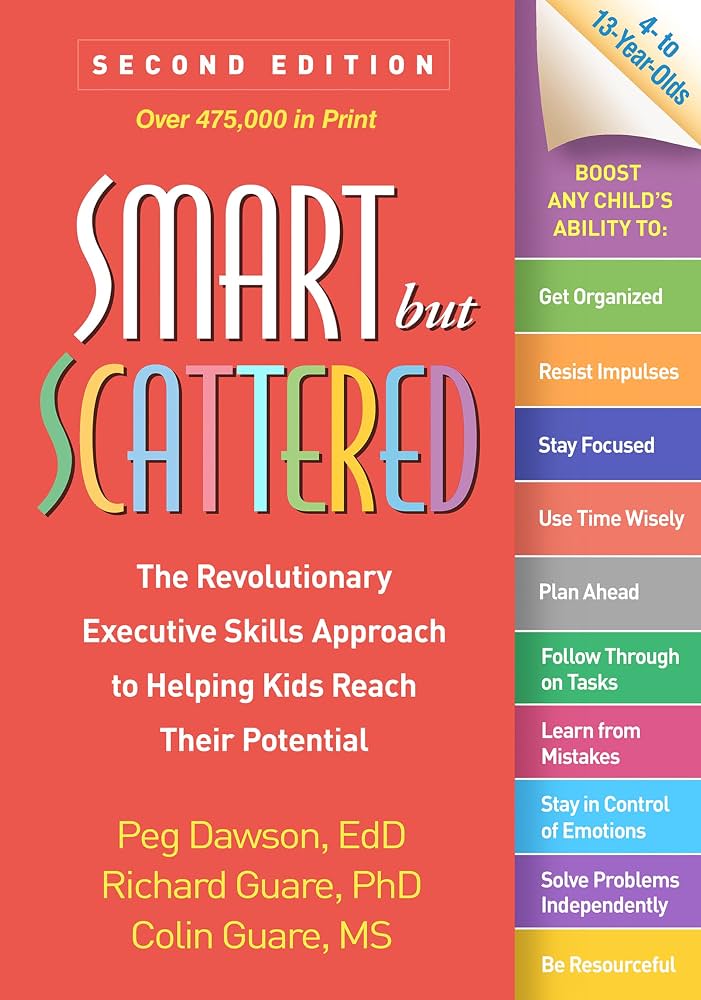
Peg Dawson, EdD · Richard Guare, PhD · Colin Guare
The updated second edition is designed for children roughly ages 4 to 13 and focuses on the executive skills behind organization, attention, impulse control and emotional regulation.
It is not an ADHD-only book, but it is highly relevant when ADHD creates repeated practical problems at home or school. The emphasis is on identifying the specific skill that is weak and changing routines around it rather than simply demanding more effort.
I recommend it especially if…your child is younger and the main problems are organization, routines, starting tasks, staying focused or emotional control.
Are you mainly trying to find out whether it is actually ADHD?
Recognizing yourself or your child in a book can be useful, but it cannot establish an ADHD diagnosis. If that is the main question, you can start with personalized screening.
Want to keep exploring?