Significant difficulties with reasoning, learning, problem-solving or judgement.
Children · adolescents · adults
Intellectual disability: understanding and diagnosis
Intellectual disability is more than an IQ score. It involves limitations in intellectual functioning and everyday adaptive skills that begin during the developmental period.
“Intellectual disability” and “intellectual developmental disorder” are terms used in different contexts. Assessment aims to understand difficulties as well as strengths and support needs.
Updated 7 October 2026
Three elements to consider together
Limitations in skills needed for everyday life, requiring support.
Difficulties that began during the developmental period, even if diagnosed later.
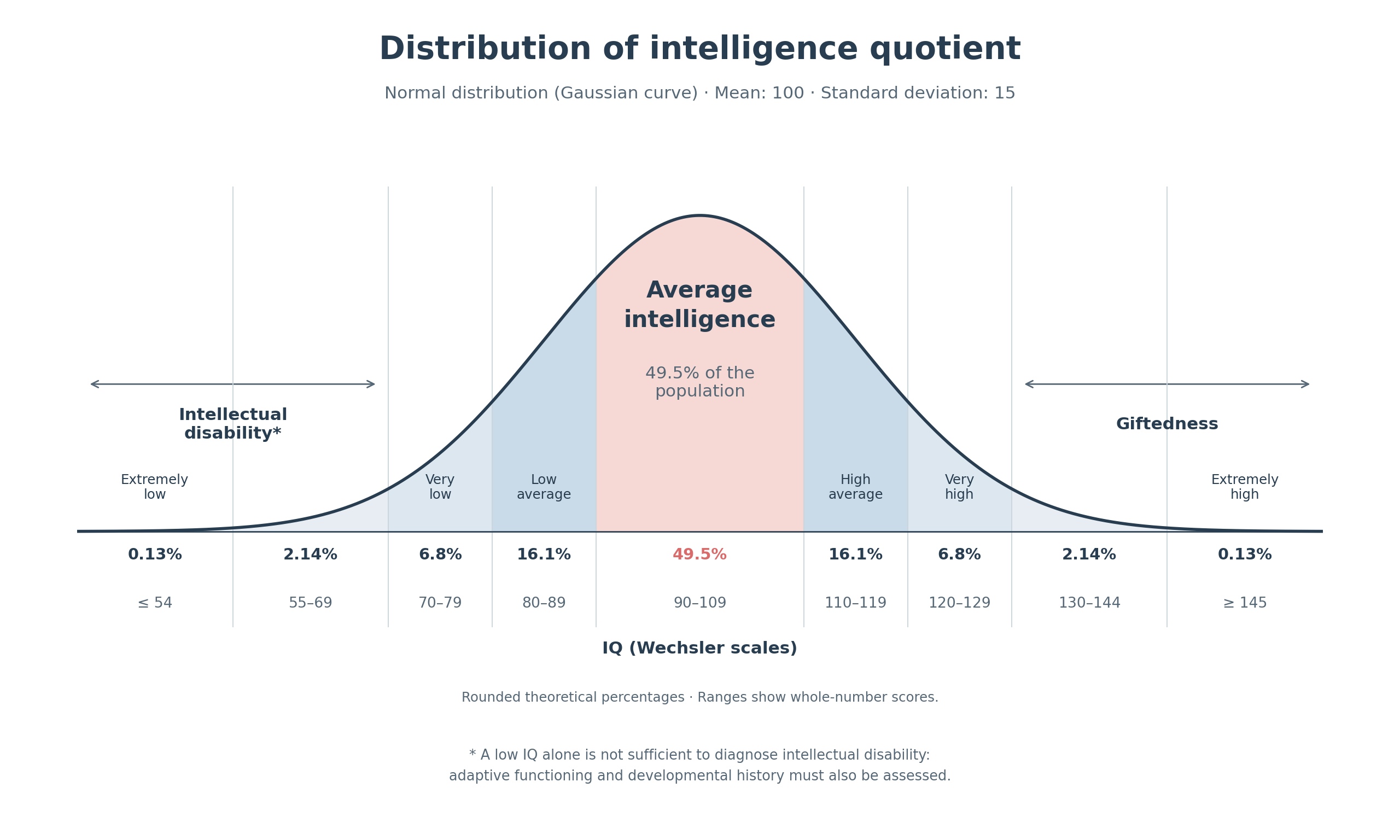
An IQ below 70 is not enough for a diagnosis.
A score around 70, sometimes up to 75 depending on measurement uncertainty, can guide assessment. It must be interpreted alongside other results, testing conditions and the person’s functioning.
Everyday adaptive functioning: three domains
Conceptual
Understanding and using language, reading, numbers, money or time concepts.
Social
Communicating, understanding social situations, maintaining relationships and exercising judgement.
Practical
Personal care, organising activities, travelling or managing everyday tasks.
Expectations depend on age, cultural context and opportunities to learn. Severity — mild, moderate, severe or profound — is assessed through adaptive functioning, rather than IQ alone.
12 difficulties that may prompt an assessment
These pointers are neither diagnostic criteria nor a checklist to score. Several may have other explanations. Their combination and impact need to be explored.
Memory
Remembering an instruction, retrieving information or applying previous learning can be difficult. Memory profiles vary from one person to another.
Reading and writing
Learning to read, spell or write may require more time and support. These difficulties may also reflect a specific learning disorder.
Exploration and curiosity
A person may explore some activities less when they are difficult to understand. This does not mean they lack curiosity: their interests and motivation should be identified and supported.
Meeting age-related expectations
Some social or practical skills may be less developed than those of peers. Calling someone “immature” is not enough to describe their needs or abilities.
Expressing and regulating emotions
Identifying an emotion, explaining it or finding a way to manage it can be difficult. These difficulties are not specific to intellectual disability.
Understanding social conventions
Unspoken rules, intentions or certain social situations can be hard to understand. Language, context and overall developmental level should be taken into account.
Reasoning
Understanding connections between pieces of information, comparing or reaching a conclusion may require concrete, step-by-step explanations. Abilities may differ across areas.
Problem-solving
In a new situation, identifying steps, choosing a strategy or changing approach can be difficult. Appropriate guidance often helps a person make better use of their existing skills.
Anticipating consequences
A person may find it hard to anticipate the effects of something they say, a choice or a behaviour. Concrete examples and explicit guidance can help.
The pace of learning
Acquiring new knowledge may take longer and require repetition. Learning remains possible; goals and methods need to be adapted.
Developmental milestones
During childhood, some skills may develop later. Developmental delay needs to be explored: on its own, it is not enough to establish intellectual disability.
Everyday activities
Keeping track of time, managing money, planning a journey or completing certain tasks may require assistance. Assessment takes age and actual opportunities to learn these skills into account.
What does an assessment involve?
Assessment combines a clinical interview, developmental history, intellectual assessment and assessment of adaptive functioning. Information from relatives or school may contribute, with appropriate consent.
A standardised test suited to age and circumstances — such as the WPPSI-IV, WISC-V or WAIS-IV — explores intellectual abilities. Adaptive functioning requires its own assessment, using interviews and, where appropriate, standardised scales.
Other possible explanations also need consideration: language difficulties, learning disorders, attention, sensory factors or educational background. Medical referral may be appropriate to investigate a cause or an associated difficulty.
Intellectual disability and autism: distinct dimensions
Autism spectrum disorder can occur with or without intellectual disability. Difficulty understanding social conventions is not sufficient to diagnose either condition.
When both are considered, social communication differences should be assessed in relation to overall developmental level. Assessment also explores repetitive behaviours, restricted interests and sensory differences.

Support tailored to individual needs
Support may include adjustments at school or work, gradual teaching of daily living skills, visual aids and, depending on needs, speech and language therapy, occupational therapy or psychological support.
Cognitive remediation may have a role in some support plans; it is not a single solution or a guarantee of bringing IQ into the typical range. Goals focus on independence, participation, learning and quality of life.
Understanding difficulties and strengths
An assessment helps clarify a person’s functioning and develop tailored recommendations or referrals.