Verbal Comprehension
The Verbal Comprehension Index assesses verbal reasoning, use of language and knowledge acquired through experience and education.
Intelligence test · age 16 and over
The WAIS-IV measures an adult’s intellectual ability, but its value goes far beyond a single IQ score. It provides a Full Scale IQ and a detailed map of the main cognitive abilities.
It is particularly useful when High Intellectual Potential (HIP) is being considered, when someone wants to understand an uneven cognitive profile, or when striking strengths and difficulties seem hard to reconcile in everyday life.
The WAIS-IV is an intelligence test for adults aged 16 and over. It provides a Full Scale IQ (FSIQ) as well as a detailed analysis of intellectual functioning.
Its value lies precisely in not reducing intelligence to a single number: the indexes and subtests show how different cognitive abilities are organized, where the strongest abilities lie and whether there are meaningful discrepancies within the profile.
The Verbal Comprehension Index assesses verbal reasoning, use of language and knowledge acquired through experience and education.
The Perceptual Reasoning Index explores non-verbal logical reasoning and visual-spatial abilities.
The Working Memory Index assesses the ability to hold information in mind temporarily and mentally manipulate it.
The Processing Speed Index measures the speed and accuracy with which certain simple visual information is processed.
Two people with similar Full Scale IQ scores can have very different intellectual profiles. When the indexes are uneven, detailed interpretation of the indexes and subtests becomes especially important in determining what the FSIQ summarizes well and what it may conceal.
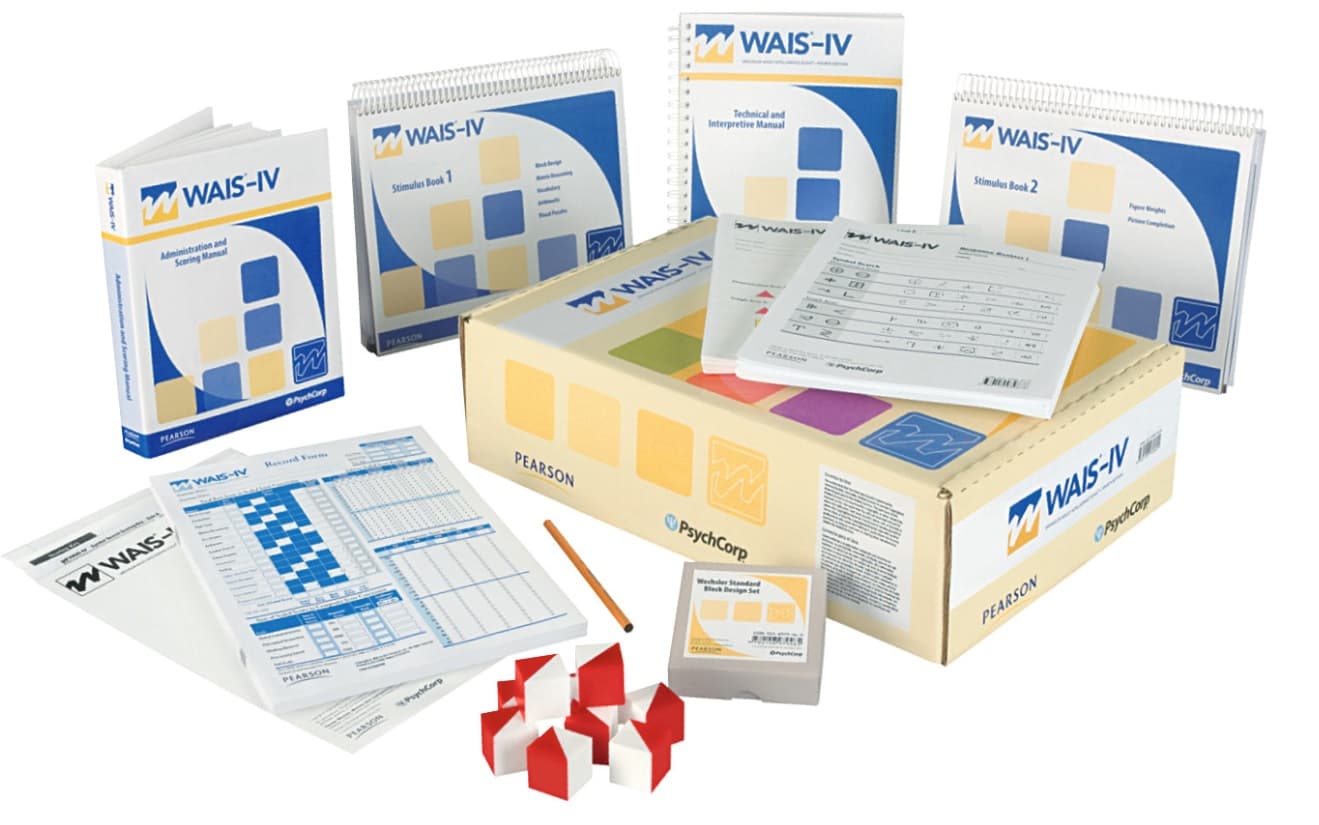
In addition to providing a comprehensive cognitive and intellectual assessment, the WAIS-IV is used to explore the presence of High Intellectual Potential.
The WAIS-IV moves beyond impressions and measures cognitive abilities using a standardized psychometric instrument.
It shows more precisely where your highest cognitive abilities lie and how they relate to one another.
A person can be exceptionally strong in some domains and much less so in others. The assessment helps make sense of those discrepancies.
High Intellectual Potential corresponds to very high cognitive intelligence. The WAIS-IV is the reference instrument for objectively assessing this possibility in adults.
An IQ of 130 is the most commonly used reference threshold for the Full Scale IQ. Interpretation should not, however, rely on that number in isolation: the coherence of the profile, the indexes and the subtests also need to be examined, especially when there are large differences between abilities.
In the relatively rare situations where the FSIQ falls very close to 130, detailed analysis of the profile and, depending on the referral question, an emotional and personality assessment can help refine the overall understanding of the person’s functioning.
For young children, the corresponding test is the WPPSI-IV.
For children and teenagers aged 6 to 16 years 11 months, the corresponding test is the WISC-V.
From age 16 onward, the WAIS-IV is used to assess intellectual ability.
The appointment lasts up to two hours. It includes a brief interview followed by the 10 core WAIS-IV subtests.
The Full Scale IQ, the four indexes and the individual subtests are analyzed in order to understand the structure of the intellectual profile.
The feedback session can take place as early as 24 hours after testing. The results are explained in detail and a written report is provided.
The WAIS-IV can be administered in French or in English. The language should be chosen so that the person is assessed under the conditions best suited to their linguistic background.
When the WAIS-IV is being considered mainly to explore possible High Intellectual Potential, it can be useful to begin with the HIP screening test. It provides an estimate of how likely HIP is and indicates whether a WAIS-IV assessment appears recommended.

A WAIS-IV report should not be limited to the Full Scale IQ. It should include the index and subtest scores, along with a detailed analysis of intellectual functioning and a clear explanation of the different components of the profile.
If you would like to complete the 10 core subtests and the 5 optional subtests, you can request an in-depth psychometric assessment.
The optional subtests do not change the Full Scale IQ or the four primary index scores. They can, however, provide a more refined assessment of certain abilities and additional information when a profile deserves closer examination, particularly when the FSIQ lies close to 130.
The 10 core subtests are supplemented by the 5 optional WAIS-IV subtests.
The full extended assessment can be completed in a single session lasting up to 2 hours 45 minutes.
Testing can also be divided across two appointments.
The WAIS-IV can be used from age 16 onward.
An IQ of 130 is the most commonly used reference threshold. Interpretation should nevertheless take the full profile into account, especially when the indexes are uneven.
No. Testing must follow standardized conditions and therefore takes place at the office. The feedback session can be arranged remotely.
No. The 10 core subtests are sufficient to calculate the Full Scale IQ and the four primary indexes. Optional subtests are useful when a more in-depth psychometric analysis is desired.
No. It may reveal certain cognitive features, but ADHD or Autism Spectrum Disorder requires a specific assessment.
When the indexes are very uneven, the profile needs to be examined in detail rather than drawing conclusions from the Full Scale IQ alone.
Estimate how likely HIP is before deciding whether to take the WAIS-IV.
Explore the likelihood of exceptionally high emotional intelligence.
For parents wondering whether a child may have High Intellectual Potential.
The WAIS-IV provides both an objective measure of intellectual ability and a detailed analysis of how your different cognitive abilities are organized.

Find out how likely you are to have High Emotional Potential!

Are you a “zebra”?

Are you highly sensitive?