Verbal Comprehension
This index reflects verbal reasoning, conceptual knowledge and the ability to use knowledge acquired through experience and education.
Intelligence test · ages 6 to 16 years 11 months
The WISC-V measures a child’s or teenager’s intellectual ability, but its value goes far beyond a single IQ score. It provides a detailed picture of cognitive functioning, strengths and the areas in which the child may need to invest more effort.
It is particularly useful when High Intellectual Potential (HIP) is being considered, when there is a mismatch between the abilities a child appears to have and what they show in everyday life, or when parents want a clearer understanding of the child’s cognitive profile.
The WISC-V provides a Full Scale IQ (FSIQ) and examines five major areas of cognitive functioning. Interpretation is therefore not limited to the overall IQ score: the way the different indexes fit together can be just as informative.
This index reflects verbal reasoning, conceptual knowledge and the ability to use knowledge acquired through experience and education.
This index explores the ability to analyze and organize visual and spatial information and mentally represent configurations.
This index assesses the ability to identify logical relationships and solve novel problems without relying only on previously learned knowledge.
This index reflects the ability to hold information in mind temporarily and mentally manipulate it in order to complete a task.
This index reflects the speed and accuracy with which a child processes certain simple visual information in standardized tasks.
Two children with similar Full Scale IQ scores can have very different cognitive profiles. One may perform very consistently across domains, while another may show large differences between indexes. Clinical interpretation of the profile is therefore essential, particularly when the Full Scale IQ does not fully reflect the child’s highest abilities.
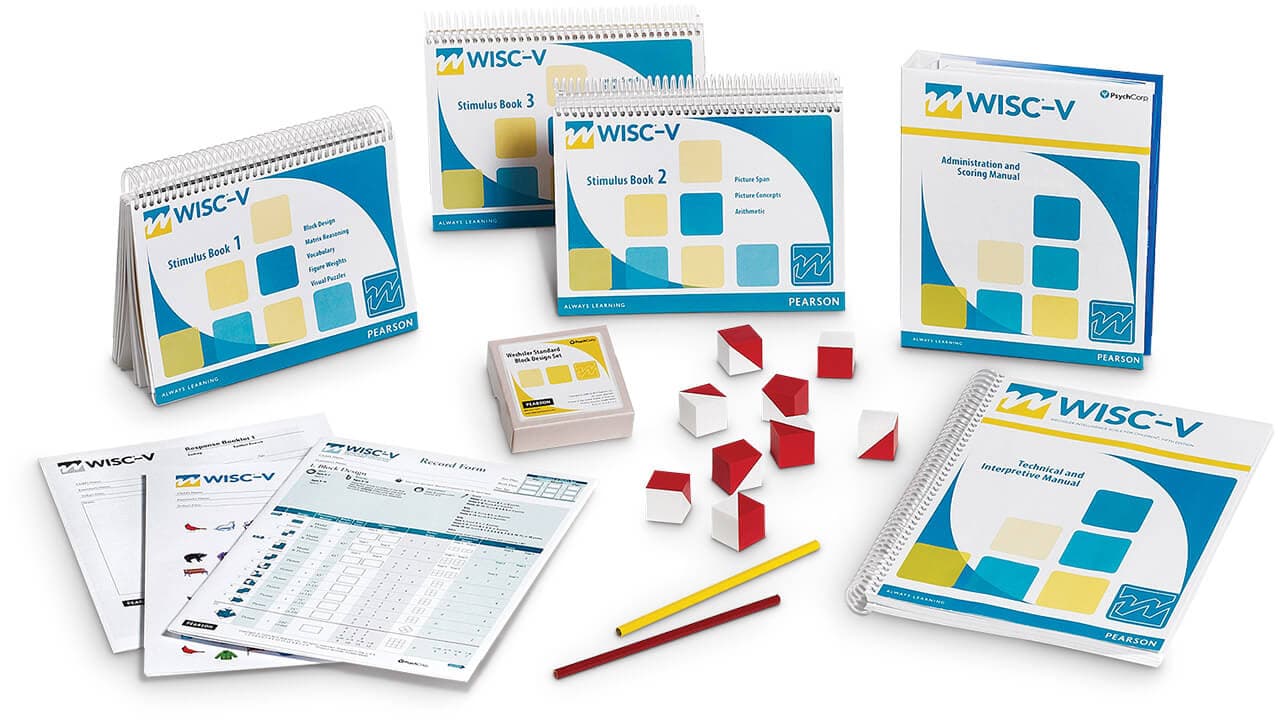
The WISC-V is particularly appropriate when intellectual giftedness or High Intellectual Potential is being considered. It can also be useful when parents want to understand why a child appears very comfortable in some areas but much more challenged in others.
The WISC-V moves beyond impressions and measures intellectual abilities using a standardized instrument.
It shows more precisely where the child’s strongest abilities lie and how those abilities relate to one another.
A cognitive profile can clarify situations in which a child seems very capable but is inconsistent, slow, unmotivated or finds particular tasks difficult.
Identifying High Intellectual Potential is not about putting a label on a child. It is about understanding how they function more accurately.
A child can have very high abilities without these being immediately obvious: they may succeed without effort and become bored, achieve only average results despite strong abilities, be extremely demanding of themselves, or appear unexpectedly inconsistent.
When High Intellectual Potential is not identified, some situations may be misinterpreted as lack of motivation, lack of effort, oppositional behavior or lack of interest. An objective assessment can help parents, the child and sometimes the school understand more accurately what is happening.
Identification can also matter personally: putting words to the way they function can help some children understand why they feel different, why certain things seem very easy to them and why others require much more energy.
The most useful part is therefore not the IQ number itself, but what can be done with the information afterwards. A good assessment can help adjust expectations, support strengths and prevent significant abilities from remaining underused or misunderstood.
For younger children, the appropriate test is the WPPSI-IV.
This is the age range covered by the WISC-V.
For adults, the corresponding test is the WAIS-IV.
The test is administered individually at the Paris office. The session usually lasts around an hour and a half, with some variation depending on the child’s age and pace.
The Full Scale IQ, the five indexes and the individual subtests are analyzed in order to understand the structure of the profile and any differences between domains.
A detailed feedback session explains the results. A written report summarizes the quantitative and qualitative analysis, and feedback can be arranged soon after testing, including as early as the following day.
I offer the WISC-V in French or in English. The aim is for the child to be assessed in the language they know best, while also taking their linguistic history and context into account.
No. The WISC-V is a test of intelligence and cognitive functioning. On its own, it cannot diagnose ADHD, Autism Spectrum Disorder, a specific learning disorder or an emotional disorder.
It can, however, reveal a pattern that suggests certain possibilities should be explored further. When attention, school, emotional or relational difficulties are central to the referral question, it may be useful to include the WISC-V within a more comprehensive psychological assessment.
When the main question is possible intellectual giftedness, the gifted child screening test can be a useful first step. It helps estimate whether the possibility is strong enough to justify a WISC-V assessment.
Yes. Strong school performance does not rule out High Intellectual Potential. Some children use their abilities to compensate or succeed without particular difficulty, while others may appear inconsistent or disengaged when they are bored.
No. It provides a Full Scale IQ as well as five primary indexes and additional information from the subtests. The profile as a whole is what makes the interpretation genuinely useful.
An IQ around 130 is the most commonly used reference threshold. Interpretation is not limited to that number, however: when the profile is uneven, the different indexes and subtests need to be examined carefully.
No. WISC-V administration must follow standardized conditions and therefore takes place at the office. Interviews and the feedback session can be organized remotely when appropriate.
No. Some results may draw attention to attentional or executive functioning, but an ADHD diagnosis requires a specific assessment and cannot be made from the WISC-V alone.
Understand possible characteristics of a child with High Intellectual Potential and why identifying it can sometimes be useful.
Read the article →Understand what High Intellectual Potential means and how it is identified through psychometric assessment.
Learn about HIP →A first step in deciding whether an intellectual ability test appears appropriate for your child.
Take the screening test →The WISC-V provides an objective measure of intellectual abilities, but more importantly a detailed picture of the child’s cognitive profile. When High Intellectual Potential is being considered, the assessment can provide much stronger answers than impressions or comparisons with other children.

Find out how likely you are to have High Emotional Potential!

Are you a “zebra”?

Are you highly sensitive?