10 signs of giftedness
Pointers to understand why HIP might be considered.
See the 10 signs →Self-confidence · Giftedness
You succeed, but feel it proves nothing. You attribute your successes to luck, circumstances or help from others. And you fear that one day someone will discover you are not as competent as you appear. This is the core of impostor syndrome.
Video in French. The article below is available in English.
Impostor syndrome is a tendency to doubt your achievements and attribute your successes to external factors, such as luck, help from others or being in the right place at the right time. A person may have objectively succeeded yet continue to feel like a fraud, afraid of being “exposed” one day.
I often observe this pattern in gifted adults and gifted children. This may seem paradoxical. Yet when someone achieves certain things very easily, this can lead them to think those achievements “do not count”: if it was easy for me, it cannot be worth very much.

The perfectionism easily sustains the problem. You notice what you cannot do more than what you already master. Meeting someone better in one area can then suddenly make your own talents seem inadequate.
Some talents were present so early, or became so natural, that they seem ordinary to the person who has them. They may even experience them as quirks rather than resources. The work then involves changing how they view their abilities, accepting their value and also accepting that they cannot excel at everything.
Impostor syndrome is not, in itself, a mental health condition. It is a very widespread experience that can nevertheless become painful when it persistently affects self-esteem, professional choices or the ability to enjoy success.

Someone convinced that they are “not really that intelligent” can dismiss the possibility of HIP for years. Screening is not intended to confirm what you want to hear, but to examine whether this possibility fits your overall functioning.
No. It is not, in itself, a mental health condition. It is a way of experiencing success and your sense of legitimacy that can nevertheless become very distressing.
Because success is not necessarily internalised as evidence of competence. It may be attributed to luck, circumstances or an ease that is considered “normal”.
It can be useful if the question of giftedness has persisted for a long time and you tend to dismiss it systematically. It offers an initial outside perspective before deciding whether an assessment is appropriate.
If the question of giftedness keeps recurring in your life but you have always found good reasons to dismiss it, HIP screening can help you move beyond self-evaluation and obtain an initial structured outside perspective.
Pointers to understand why HIP might be considered.
See the 10 signs →Perfectionism, intensity, a need for meaning and feeling out of step at work are often closely connected.
Read the article →An assessment objectively evaluates cognitive functioning and moves beyond impressions about your own intelligence.
Book an appointment →
Reading can help you learn more about giftedness and make better use of the abilities it brings.
Discover 10 key signs of giftedness. Every gifted person is unique, and few have all 10 characteristics!

The concept of narcissistic abuse is particularly useful for understanding the manipulation experienced by many people with Asperger syndrome or giftedness

High Emotional Potential corresponds to extremely high emotional intelligence…
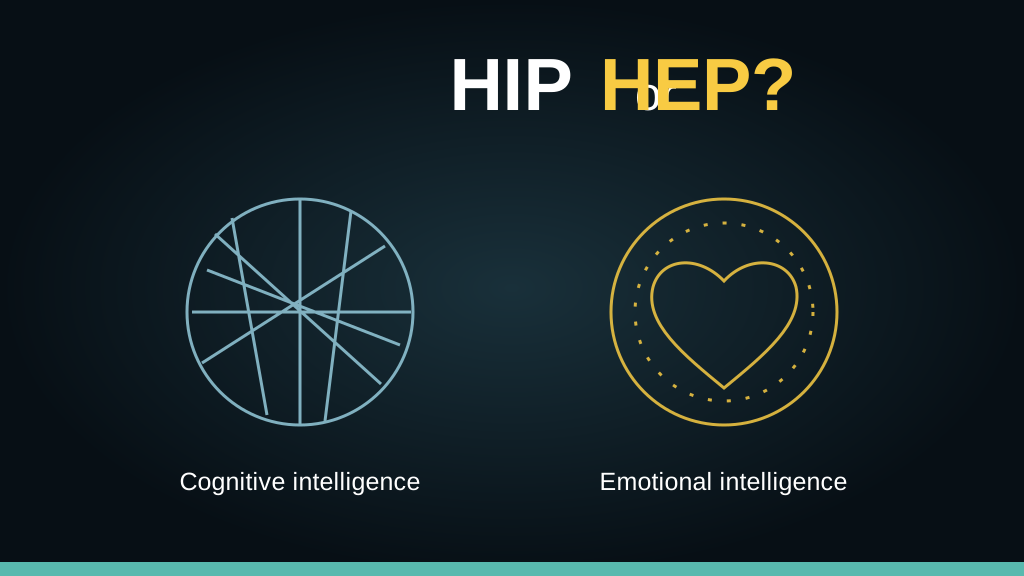
Do you identify more with High Intellectual Potential or High Emotional Potential?

Branching thought is a network-like way of thinking: each idea gives rise to several others, which in turn lead to more ideas.

Do you identify more with the characteristics of a gifted person or those of a person with Asperger Syndrome?

Bright, passionate and different, gifted women often hide the qualities that make them distinctive.

Explore the possibility of High Emotional Potential!

Are you a “zebra”?

Are you highly sensitive?