Intense emotional variation
A wide emotional range can be observed in some gifted people as well as people with bipolar disorder.
Differential diagnosis · Giftedness
Fast thinking, strong emotional intensity, creativity and an urge to act: some features may look similar from the outside. However, similar traits do not mean the underlying mechanism is the same. The video presents ten shared features that explain why this question sometimes arises.
Video in French. The article below is available in English.
A wide emotional range can be observed in some gifted people as well as people with bipolar disorder.
Concentration may appear variable, particularly when the mind is heavily engaged or several ideas follow one another rapidly.
The feeling that ideas move very quickly can occur in both situations, but needs to be placed within personal history and clinical context.
Emotions, projects, relationships or commitments can be experienced with considerable intensity.
Some people describe a need to move quickly from idea to action.
Confidence can fluctuate and be weakened by feeling out of step or periods of difficulty.
Marked sensitivity to stimulation can be part of the picture some people describe.
Numerous ideas, a rich imagination or considerable inventiveness can be present.
Anxiety can accompany many forms of functioning and cannot, on its own, distinguish between them.
Feeling out of step can be very strong, but its origins must be understood rather than inferred from a single sign.
High Intellectual Potential and bipolar disorder can also coexist. Differential diagnosis relies on the person’s complete history, the timing of changes, whether they are episodic or stable, sleep, behaviour and effects on daily life. HIP screening explores giftedness; it does not diagnose bipolar disorder.
An appropriate clinical assessment is important, particularly when there are periods of marked changes in mood or behaviour. The aim is to understand what actually explains your functioning, rather than replace one hypothesis with another.
Yes. They are not mutually exclusive. This is precisely why a single explanation should not be sought when the picture is complex.
No. It explores High Intellectual Potential. The question of bipolar disorder requires an appropriate clinical assessment.
Because some visible features can look similar, such as intensity, rapid ideas, creativity or emotional variation. Their timing and overall pattern allow deeper understanding.
If you recognise several of these characteristics and the question of HIP keeps recurring, screening can be a first step. If the situation is more complex, an assessment considers the whole picture rather than a few similarities.
Understand why some presentations look similar and why several forms of functioning can coexist.
Read the comparison →An initial exploration of High Intellectual Potential.
Take the screening test →A broader assessment is appropriate when several possibilities need to be distinguished or understood together.
Book an appointment →
Being a “zebra” is another term for giftedness, high potential or intellectual precocity. Jeanne Siaud-Facchin introduced this term because zebras are difficult to tame…

Here are the 10 indications of High Emotional Potential: empathy, intuitive thinking, understanding non-verbal messages, heightened sensitivity…
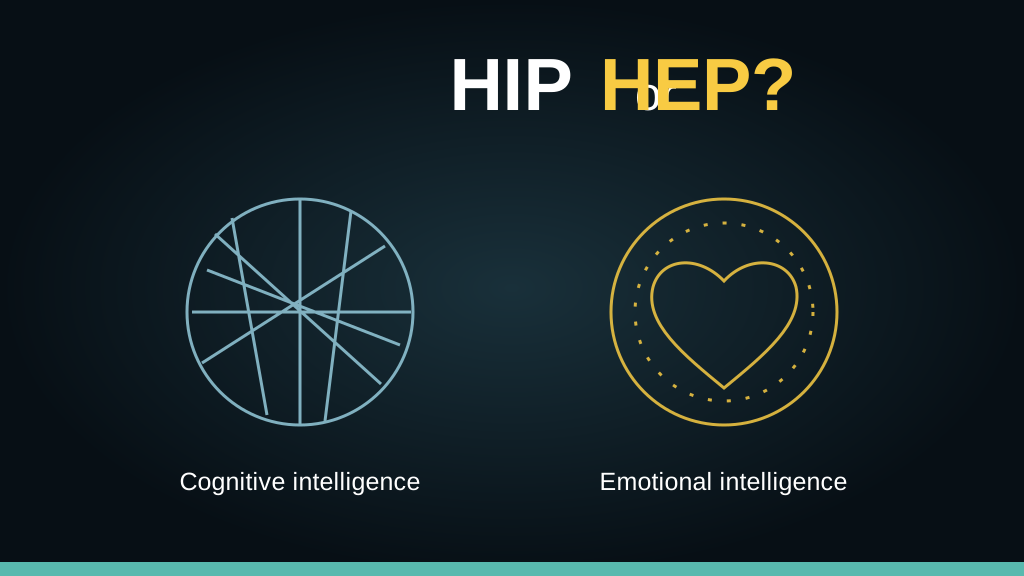
What are the differences and similarities between High Intellectual Potential and High Emotional Potential?

Branching thought is a network-like way of thinking: each idea gives rise to several others, which in turn lead to more ideas.

Do you identify more with the characteristics of a gifted person or those of a person with Asperger Syndrome?

Bright, passionate and different, gifted women often hide the qualities that make them distinctive.
Explore the possibility of High Emotional Potential!
20 characteristics of gifted adults!

Are you highly sensitive?